
JavaScript reduce() is a powerful an array methods which is not a beginners friendly. Once you understand how reduce works. You forgot the other loop. help of reduce you can create a code sort and more readable format.
In this blog I guide you to What is reduce method?, Syntax with real word example, Advantage and Disadvantage of reduce methods, and Different between map(), filter(), and reduce().
If you are new to JavaScript, start with this complete guide on how to learn JavaScript in 2026 from beginner to advanced.
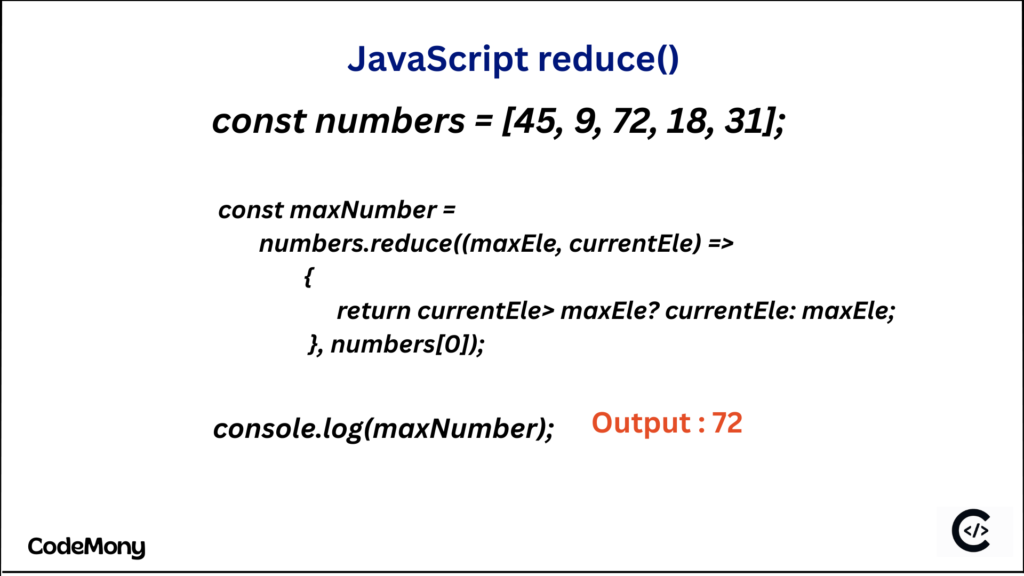
What is JavaScript Reduce?
The reduces methods is execute the call back function one by one on every elements of provided array. it is return the result as a one accumulated value. it is working with array for only. It is useful for calculation process.
Syntax of reduce()
array.reduce((accumulator, currentValue) => {
  return updatedAccumulator;
}, initialValue);
There are main three params of reduce methos.
accumulator : Store the latest result of every element.
currentValue : current value of array element.
initialValue : Staring value of an array.
Why Use JavaScript Reduce?
You can use reduce() when you want to:
Large calulation.
Data transfer.
Replace complex loops.
Count of the daily/yearly total.
Sum of the all product price.
GST Calculation.
JavaScript reduce real world example
We will understand with Shopping Cart Total with Tax & Discount example. We have a e-commerce shopping cart where each product has a price and quantity. We need to calculate the final price with GST and discount.
Card Data
const cart = [
  { product: "Laptop", price: 50000, quantity: 1 },
  { product: "Mouse", price: 500, quantity: 2 },
  { product: "Keyboard", price: 1500, quantity: 1 },
  { product: "Data-cable", price: 100, quantity: 1 },
  { product: "Pen drive", price: 500, quantity: 1 },
];
We use the reduce function for Calculation for price including GST and discount.
const totalAmount = cart.reduce((total, item) => {
  return total + item.price * item.quantity;
}, 0);

const tax = totalAmount * 0.18; // 18% GST
const discount = 999;

const finalAmount = totalAmount + tax - discount;

console.log(finalAmount);
OUTPUT
Cart total

Laptop: 50,000 × 1 = 50,000

Mouse: 500 × 2 = 1,000

Keyboard: 1,500 × 1 = 1,500

Data-cable: 100 × 1 = 100

Pen drive: 500 × 1 = 500

Total Amount = 53,100

Tax (18%)

18% of 53,100 = 9,558

finalAmount = totalAmount + tax - discount

finalAmount = 53,100 + 9,558 - 999

finalAmount = 61,659
Mistakes with JavaScript Reduce
Common mistakes Many developer Forgetting the set initial values. and is not possible to the string. reduce methods is powerful but avoid if you have small task which You can handle with map methods. and Forgetting to Return statement.
Also you can learn the reduce() using official JavaScript reduce method.
Advantages of Reduce method
The most important advantage of the JavaScript reduce methods is the transfer entire array of object in to the single value. Compare to other like for loop, filer(), forEach(). such as a Calculate the total price. Grouping data by Category.
JavaScript reduce methods can replace the for loop or multiple array methods.
If logic is clear then reduce is provide the handle data with less coding compare to other loops.
Array reduce JavaScript is a experience developer friendly.
Disadvantages of Reduce method.
JavaScript reduce method is hard to understand the Accumulator and callback function.
It is not a Beginners friendly.
Developer must proper knowledge of how reduce methods is works.
Many time reduce methos debugging is complex.
Many developer are forgot to add the Initial value and facing the syntax errors.
JavaScript Reduce() VS Map() VS Filter()
map(), filter(), and reduce() are all JavaScript array methods with different syntax and purpose.
reduce() It is combine every value in a single value. It is return a Single value. reduce use for the combine large data in to a single value. Original and return array length is not be same.
map() is change the value of an every element. It is return a new array. map is use for the transfer data. Both array length may be same.
filter() is remove the un used elements. It is return a new array. filler is use for the select specific data. Both array length not be same.
If you want to transform arrays, read our guide learn JavaScript conditional filtering in our JavaScript filter tutorial.
Is reduce() slower than other array methods?
No, JavaScript reduce is not slower. Performance is similar to other array methods.
Is reduce method used in real-world applications?
Yes, It is used in real world such as such as shopping cart calculations, analytics dashboards.
Can JavaScript reduce replace multiple array methods?
Yes,
Is the JavaScript reduce method’s return value always an array?
No, the JavaScript reduce method does not always return an array.
Helpful information and easy to understand